Category: Most Recent

Most recent articles

  • Sleep is not for the weak

    Sleep is not for the weak

    I am usually quite hesitant to talk about the issue of sleep because it feels hypocritical coming from me. I struggle with sleep, and I have for a long time. It therefore feels ironic to speak to anyone about the benefits of sleep and how to get good sleep when I would benefit from this advice the most.

    Or perhaps this is precisely why I am well placed to do so. Having lived on the other side, I understand how unsustainable poor sleep habits are, and the heavy consequences borne by those for whom quality sleep is a luxury rather than a given.

    My struggles with sleep allegedly started in infancy. My mother claims that I would reserve whatever sleep I had for the day, then rise proudly and piercingly loud at night, much to the anguish of those tasked with babysitting me after a long day of being adults. She concluded that I would grow up to ply some nocturnal trade.

    I have always found it easier to stay up late to work, study, or think, and then sleep in the wee hours of the morning, starting my day in mid-morning. When visitors came to my mother’s house, I would often be asleep, and the conclusion was that I must be very lazy, especially being a boy. What do you mean by sleeping during the day?

    At school, I struggled with early mornings from primary school all the way through university. Missing many morning classes meant compensating with long hours of self-study, covering what others had already been taught. When I eventually began working on a vocation that required night shifts (prophetic, in hindsight), I excelled at working through the night but frequently clashed with my daytime supervisors.

    The struggle to do what came naturally to me was constantly at odds with how the world around me was ordered. Often, I had to adapt. Adaptation inevitably meant shorter hours of sleep, dependence on an alarm clock, and persistent daytime fatigue.

    This is a familiar story for many of us. Call it different versions of the same book.

    Many are driving with the handbrake on.

    Irritable. Fatigue. Headaches. Difficulty concentrating. Less productive, or entirely unproductive.

    And you know this is true. Morning coffee is not optional; it is a ritual. Alarm clocks so loud that they could be heard on the moon, yet they are snoozed in unison. People steal winks early in the morning, when they should be most fresh and energized from a good night’s rest. In offices, classrooms, and public transport, you see it everywhere. Wake up early to go to work. Sleep on the way to work. Sleep at work. Sleep on the way home from work.

    If you are so tired that you fall asleep at every available opportunity, is it possible that this is your most cognitively alert and productive self?

    I would never have begun to take the issue of sleep seriously had two things not happened.

    The first was that I began working with mental health patients. In these five years, I can state with certainty that poor sleep, or the lack of it, has been the single most common symptom I have encountered. Sleep is a massive problem, and when it is bad, it is profoundly distressing. This made me curious about sleep and what it truly is.

    Then the second thing happened: I read Why We Sleep by Matthew Walker. It is a deeply insightful book, and if you didn’t think sleep was a big deal, it turns out there is an entire branch of medicine dedicated to it: sleep medicine.

    With my curiosity piqued, my own challenges with sleep came into sharper focus. I needed to help myself, but I also realized that this was not a problem unique to me. Many others were battling it too, knowingly and unknowingly. Some were fighting to stay awake in environments that demanded alertness. Others were desperately searching for elusive sleep. Still others believed they could survive on three hours a night and that their bodies would simply adapt and move on.

    Sleep is a biological urge. The longest time on record without sleep is 18 days, 21 hours, and 40 minutes. The Guinness World Records no longer recognizes attempts to break this record because of the serious health concerns associated with both acute and chronic sleep deprivation.

    All animals sleep. Even those in extremely dangerous environments, surrounded by predators, find ways to sleep while flying, while swimming, or even by resting one hemisphere of the brain at a time. Nobody escapes sleep. Nobody should.

    Learning about sleep continues to be a deeply fascinating journey, and hopefully one I can convince you to join me on. Learn a few crucial things. Sleep better. Sleep longer. Get more life out of your days.

    Sleep is not for the weak.

  • Sigmund Freud, Cocaine and the birth of Local Anaesthesia

    Sigmund Freud, Cocaine and the birth of Local Anaesthesia

    You must be wondering about this title and what those three could have in common: Freud, the father of psychoanalysis; an illegal hard drug that has caused death and destruction to many; and a medical intervention that changed how medicine, especially minor surgical procedures, is performed.

    Sigmund Freud was born in 1859, an intellectual colossus, a clever neurologist, an inquisitive scientist, and a solver of problems that plagued the human mind. He was as controversial as he was brilliant.

    In the 1880s, he was living in Vienna, where he had studied and qualified as a medical doctor at the University of Vienna. He was a talented scientist with ambitious goals, eager to discover the next groundbreaking discovery that would establish him as a leading figure in the scientific world. He dabbled in various fields, including physiology, dermatology, and neurology, before settling into psychiatry, to which he would dedicate the rest of his life.

    At around the same time, a popular drink was making the rounds across Europe, known as Vin Mariani. This was the innovation of Alberto Mariani, a French entrepreneur who, having heard of the purported properties of the coca leaf following the Spanish invasion of South America, began importing the leaf to Europe. He steeped the leaves in French wine, producing a much-touted drink said to revitalize its users.

    This was the precursor to French wine coca in America and, subsequently, Coca-Cola, before it was reformulated in 1904.

    In the late 1850s and early 1860s, the cocaine compound had been chemically isolated, and its chemical formula described. Scientists began to document its apparent effects, such as numbing of the tongue, dilation of pupils, and narrowing of blood vessels.

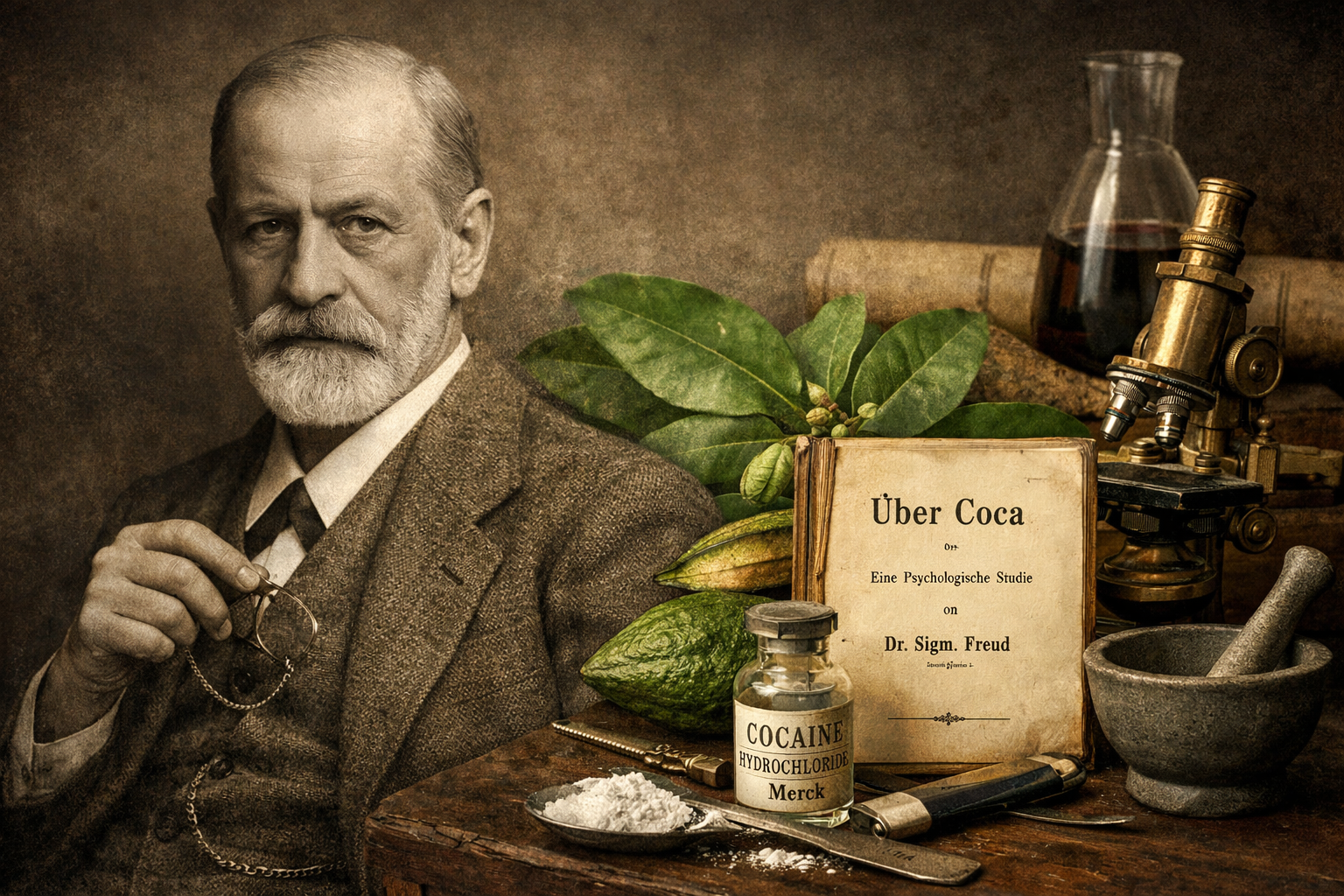
    Freud, a young doctor and researcher with interests in psychiatry, neurology, and psychoactive substances, stumbled upon these findings and, given the popularity of Vin Mariani, began to immerse himself in the science of cocaine. Being a true “researcher,” he experimented on himself and on those close to him, with his wife Martha, often referred to as his cocaine companion.

    He soon discovered and personally experienced the stimulant and anesthetic properties of cocaine, some of which had already been noted, though without notoriety, in medical journals.

    Within a year, he published a 70-page work on the benefits of cocaine use titled Über Coca. At the time, Vienna was not only the center of medicine but also a driver of Europe’s intellectual life. He deliberately titled the work “coca” rather than “cocaine,” presenting it as a review of a plant rather than the promotion of a new drug, though in reality the distinction was blurred.

    A researcher making proclamations about coca or cocaine from Vienna was a significant event, and the publication took the scientific world by storm. It contributed to cocaine’s moral legitimacy and cultural acceptability. After all, if doctors said it was good, it must be.

    With his interests rooted in psychiatry and neurology, Freud focused on cocaine’s effects on depression and fatigue and claimed it could cure morphine addiction, which was a major problem at the time, particularly given war-related injuries and the widespread medical use of morphine. He recognized that cocaine might have other properties, including anesthetic ones, but did not pursue them, instead remaining focused on his primary interests.

    A friend, colleague, and ophthalmologist at the same university, Dr. Karl Koller, was introduced to cocaine. Having read Freud’s publication and worked under his tutelage to understand its effects, Koller chose instead to focus on cocaine’s action on the eye.

    In a remarkable one-hour experiment at the Institute of Anatomy, involving only a few particles of cocaine, distilled water, and a frog, they were able to completely anesthetize one of the frog’s eyes. They repeated the experiment on a rabbit, then a dog, and finally on each other, with striking results. Both Koller and Freud had used cocaine before, but neither had anticipated this revolutionary discovery.

    With scientists from an eminent university in a city synonymous with science advocating for cocaine’s effects, it soon became ubiquitous and used for nearly everything. Pharmacy counters dispensed vitality drinks, lozenges for singers, solutions for dental, eye, and ear procedures, drops for teething babies, cures for headaches and anxiety, and purported treatments for addiction to alcohol and morphine, among many others. While these discoveries did not mark the beginning of a cocaine mass market, they had a profound impact.

    However, within three short years, cocaine, the miracle substance so widely touted and freely used and administered by Freud, began to reveal its darker side. Those using it for depression experienced severe rebound symptoms, often worse than before, with paranoia and hallucinations becoming increasingly common.

    This ended tragically for Freud when his close friend Dr. Fleischl-Marxow, whom he had been treating for morphine addiction, developed cocaine-induced psychosis. This was at least fifty years before the first antipsychotic medication was ever produced. His friend died a few years later, addicted to morphine, cocaine, and suffering from psychosis, which abruptly ended Freud’s public involvement with cocaine.

    “My studies with cocaine ended prematurely, and I would have to be content predicting the novel uses that would be discovered for this drug,” Freud later wrote in his memoirs. Had he taken a deeper interest in ophthalmology or surgery, he might have been credited with the discovery of local anesthesia, having laid much of the groundwork, popularized the subject, and strongly advocated for its experimentation and use.

    The father of psychoanalysis, widely acknowledged for transforming the management of mental illness, advancing our understanding of human behavior, and illuminating the influence of childhood experience on adult life, was also, surprisingly, one of the earliest and most influential medical advocates for cocaine use and participated in promoting the early cocaine epidemic.

    This makes Freud a morally complex, almost antiheroic figure in the history of medicine, one who continues to be celebrated and criticized in equal measure.

  • Beyond the Doctor’s word: Navigating patient choice

    Beyond the Doctor’s word: Navigating patient choice

    Ethics is a key part of medicine, and those who study and practice medicine are taught and expected to abide by ethical standards that relate to the real world, as well as to key principles within their profession. There are four key principles: autonomy, beneficence, non-maleficence, and justice.

    Autonomy is about free will in making informed and independent medical decisions. To be able to exercise this, a person must have capacity (the explicit ability to receive information, understand it, and utilize it to make a decision that they can communicate) and must receive adequate information necessary to make an informed decision.

    Beneficence ensures that health workers always act in the patient’s best interests. Non-maleficence emphasizes the Latin phrase “Primum non nocere,” i.e., the principle of “first, not harm.” Justice requires that we treat all people fairly and distribute medical resources equitably.

    Of these, autonomy is my favorite principle—not because it is the one I adhere to above the others, but because it is the one I find most nuanced and convoluted in practice.

    The Universal Declaration of Human Rights (UDHR), in its first article, states that all humans are born free and equal in dignity and rights. Article 3 speaks to the right to life and liberty; Article 18 to freedom of thought and conscience; and Article 19 to opinion and expression. It further states in Article 25 that everyone has the right to a standard of living adequate for their health and well-being and that of their family. In summary, everyone has the right to the highest attainable quality of health and well-being, but in the process of seeking its provision, they must remain free and informed in choosing how they would like to receive this care, provided it does not infringe on the rights of others or the law. Hence, autonomy.

    Why is autonomy interesting?

    Medicine has a long history of paternalism, where medical decisions were outsourced by those seeking care to health professionals, and, in turn, professionals developed an inclination to do so—sometimes with little or no reference to the affected individual. There is an apparent “god complex” that seems to afflict health workers, but this is often an outcome of systemic flaws rather than individual attitudes. Healthcare systems favor certain ways of doing things aimed at standardizing care, ensuring patient safety, improving outcomes, and reducing legal liability.

    However, strict insistence on clinical protocols and guidelines, hierarchies in rank, responsiveness to time pressures (particularly in critical care and emergencies), and limited resources often result in conflict where the interests of the institution are at odds with those of the individual patient. For example, a patient may consent to a high-risk surgical procedure but refuse a blood transfusion. Autonomy is key here, yet institutional procedures and clinical judgment may disagree.

    At the outset, a patient may know little about their medical condition or the dynamics of treatment, creating a degree of information asymmetry. The role of the healthcare provider in this case is not to have the patient defer decisions to them; rather, it is to act as a facilitator or partner, ensuring that the patient has sufficient and relevant information to make decisions appropriate to their circumstances. This reduces information asymmetry and allows doctors to support the patient in decision-making rather than deciding on their behalf.

    Notwithstanding this, allowing a patient, or a guardian acting for a minor, to make decisions is limited by what the law permits. The Children’s Act in Kenya, for example, ensures that guardians act in the best interests of minors and provides recourse for health workers should guardians act contrary to this obligation. Similarly, certain interventions may be legally restricted in specific jurisdictions, such as medical abortions, physician-assisted suicide, virginity testing, or the use of unproven therapies. Therefore, while autonomy should be respected, the health worker must recognize legal boundaries and seek conciliatory outcomes that do not isolate the patient or dismiss their request outright.

    Autonomy is a good thing. It supports the patient and allows the doctor to practice in an ethically sound manner, often resulting in the best possible outcomes. It frees the doctor from decisions biased by personal values, discourages a one-size-fits-all approach, and, crucially, helps clinicians recognize their limitations.

    In the same way, it helps patients receive treatment that makes sense for them based on their circumstances, values, preferences, and resources, and increases the likelihood that they will complete or adhere to a treatment plan.

    While it is undoubtedly difficult to ensure autonomy for all patients in all circumstances, the priority remains ensuring that health workers understand the value of encouraging autonomy in practice, as good health outcomes depend on it.

    In a subsequent article, we will explore what happens in situations where capacity is impaired, and care becomes involuntary.

  • Why I am writing

    Why I am writing

    Mental health is a world that few truly understand. It is also a world in which I have been privileged to work for the last four years. In this time, I have trained and worked at the largest mental health institution in East and Central Africa – the Mathari National Teaching and Referral Hospital, with a bed capacity of 700 patients and an outpatient department that runs 24/7 year-round. This institution was officially opened in 1901.

    I have also had the opportunity to work in a smaller setting in a different part of Kenya. Over these years, I have attended to thousands of patients, both those suffering from diagnosed mental illness and those experiencing poor mental health.

    During this time, I have been well-positioned to observe and experience the attitudes towards mental health as held by the community, other health workers, and the patients themselves. I gain these insights through experiences with patient relatives, discussions with colleagues, and interactions with people who discover that I work in mental health.

    For many, mental health work sparks curiosity: they ask what mental illness is like, what it is like working with mentally ill people, whether I can tell if they themselves are mentally ill, whether I can “read their minds,” how they can improve their mental health, and most commonly, why I chose this field. These insights give a glimpse into the perception of mental health.

    I chose to join this discipline because of my academic interest in psychology and human behavior, because I recognized a desperate need for mental health services and personnel, and because there was an opportunity to pursue the discipline while helping those who needed support. I believed I could join others “holding hands in service” and offer something, even if I was no superhero.

    Having already trained in biological sciences and practiced general health for several years, I might have assumed I knew a lot about mental health. I couldn’t have been more wrong.

    I would describe working in mental health as a cliff dive into the ocean of real life. There can be no gentle entrance, because mental health work immediately thrusts you into experiences alternate and sometimes alien to those we frequently experience in our daily lives.

    Every day is different. Each experience is uniquely intense.

    The emotional weight from the story of a divorce, then one who is bereaved, then one who has suffered trauma of war. Sometimes they are the first three encounters before tea.

    The ambiguity of hearing voices, from nowhere and no one in particular. Troublesome voices, sometimes dangerous voices that no one else can hear and that refuse to be silenced.

    The internal conflict of empathizing with a tragic story while having to maintain professional boundaries (distance) and authority.

    The unpredictability of a session that begins lighthearted but erupts into violence almost without warning.

    Perspective, perhaps, has been the deepest lesson. If you have lived a shielded, carefully curated life, mental health work suddenly disrobes you, demanding comfort with the unknown, unseen, and unexpected. The word “normal” becomes the most abnormal concept, and anything becomes expected—or at least accepted.

    These experiences made me realize how much we do not know, how many people do not know, and how much we all need to learn. Conversations around mental health, illness, trauma, and recovery are gaining momentum, but stigma remains significant. Subtle discrimination, mingled with deep love and compassion, is often what I witness from families of those living with mental illness. Poor access to affordable, sustainable care continues to be the greatest challenge.

    Working in mental health is a journey that continually reveals, just as it confuses, draws excitement and despair in equal measure, humbles unapologetically, and teaches an effortless fusion of science with art.

    It is this journey that I will try to share. I hope to help those who wish to understand, those who may wish to participate and make a difference, and those who simply wish to know. We in the discipline have a responsibility to strengthen the human connection in mental health, advocate more fiercely, show the hidden face of mental health within medicine, fight for better access to quality care, and influence communities to support each other.

    So here I am. Trying.